
| Author | Damian Łysomirski |
| Supervisor | Grzegorz Galiński, PhD |
| Thesis type | Master’s (MSc) thesis |
| Defence date | 2024 |
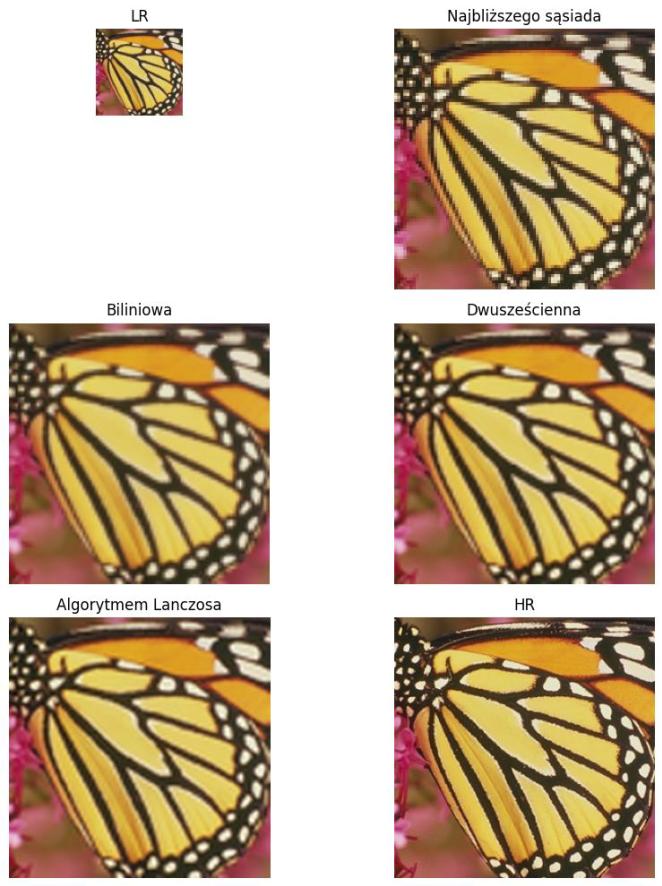
The rapid development of digital technologies has created a demand for high-resolution images. Unclear, blurred images with a small number of pixels are unpleasant to the eye. Image resolution enhancement, also known as super-resolution, is a technique for generating high-resolution images from their low-resolution counterparts so as to obtain a clear, sharp image with more pixels and no visible distortion. Both classical interpolation methods and deep learning methods are used for this purpose.
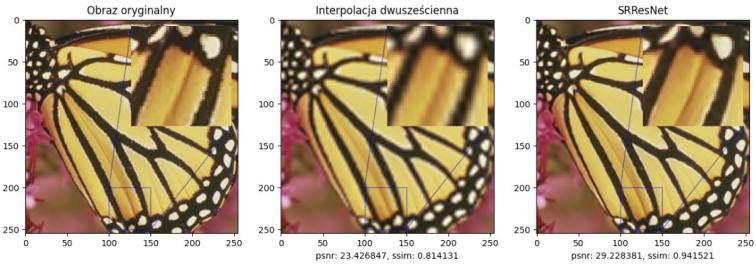
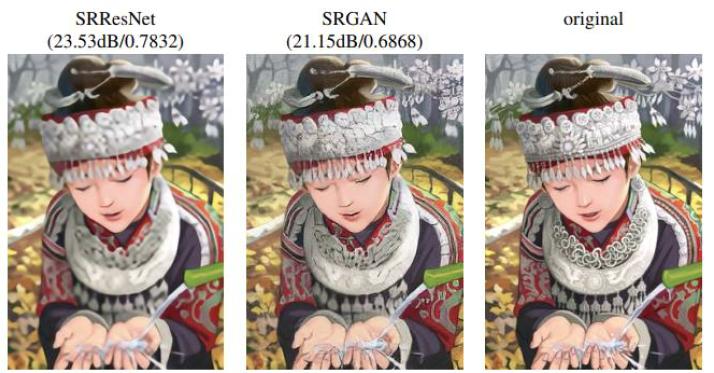
The aim of the thesis was to apply deep neural networks to image super-resolution. The thesis describes neural network models used for super-resolution, and four of them were implemented by the author: SRCNN, ESPCN, VDSR and SRResNet. All models were trained under uniform conditions, with the same assumptions and constraints, using a training set built from the DIV2K dataset. The models were then tested in a uniform test environment, and the results were compared with one another in terms of quality, efficiency and the ability to adjust the scaling factor, as well as with classical image resolution enhancement methods (interpolation methods). The thesis concludes with an analysis of the results obtained and a discussion of future research directions.